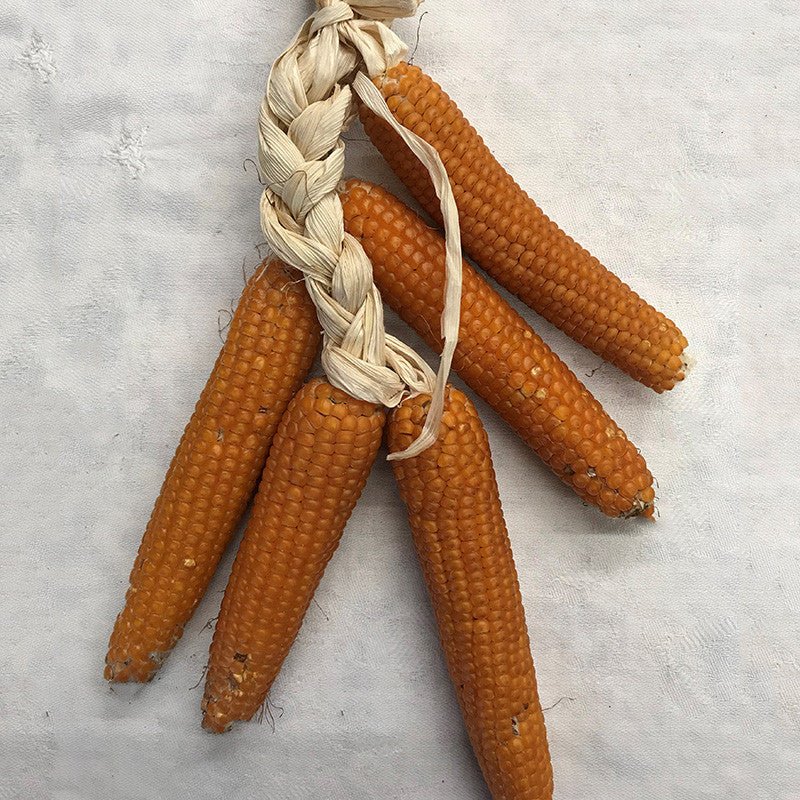
Yellow Guinea Flint Corn Seeds (Zea mays indurata cv.)
Thomas Jefferson grew a dozen varieties of “Indian Corn” (Zea mays) at Monticello, starting in 1774. While serving as Minister to France, Jefferson requested seed from home for “homony-corn…which we used to make 20 barrels a year for table use, green, in homony, and in bread.” Flint corn is traditionally used to make hominy, or hulled corn, and milled for cornmeal.
A prolific, short-season corn with small, 6” cobs, Yellow Guinea Flint Corn was brought from Cuba to the American Southeast in the pre-colonial era and from there made its way to Africa where it was further developed to bear up to eight ears per stalk.
Direct sow seeds outdoors after all danger of frost has passed.
Approximately 40 seeds per packet.
Original: $4.95
-65%$4.95
$1.73Yellow Guinea Flint Corn Seeds (Zea mays indurata cv.)
Thomas Jefferson grew a dozen varieties of “Indian Corn” (Zea mays) at Monticello, starting in 1774. While serving as Minister to France, Jefferson requested seed from home for “homony-corn…which we used to make 20 barrels a year for table use, green, in homony, and in bread.” Flint corn is traditionally used to make hominy, or hulled corn, and milled for cornmeal.
A prolific, short-season corn with small, 6” cobs, Yellow Guinea Flint Corn was brought from Cuba to the American Southeast in the pre-colonial era and from there made its way to Africa where it was further developed to bear up to eight ears per stalk.
Direct sow seeds outdoors after all danger of frost has passed.
Approximately 40 seeds per packet.
Product Information
Product Information
Shipping & Returns
Shipping & Returns
Description
Thomas Jefferson grew a dozen varieties of “Indian Corn” (Zea mays) at Monticello, starting in 1774. While serving as Minister to France, Jefferson requested seed from home for “homony-corn…which we used to make 20 barrels a year for table use, green, in homony, and in bread.” Flint corn is traditionally used to make hominy, or hulled corn, and milled for cornmeal.
A prolific, short-season corn with small, 6” cobs, Yellow Guinea Flint Corn was brought from Cuba to the American Southeast in the pre-colonial era and from there made its way to Africa where it was further developed to bear up to eight ears per stalk.
Direct sow seeds outdoors after all danger of frost has passed.
Approximately 40 seeds per packet.